
If you searched "AI agent frameworks" in 2024 you got a list dominated by LangChain, AutoGPT, and a half-dozen experimental projects that no longer ship. That list is wrong now. The space consolidated, the production-grade options narrowed, and the protocols that actually matter shifted. This guide is the 2026 version: which frameworks are worth your time, which ones to ignore, and how to pick between them for your specific use case.
I have deployed agents in production at QIT Solutions across MSP automation, internal-process bots, document-heavy RAG systems, and multi-step workflows that touch ten SaaS tools. The framework choices below come from that experience plus a lot of postmortems on what worked and what did not.
If you are completely new to agents, start with my AI agent frameworks for beginners guide first. It covers the fundamentals this article assumes you know.
How the landscape changed from 2024 to 2026
Three big shifts reshaped the agent space in the last 18 months:
1. Multi-agent hype calmed down. AutoGPT, BabyAGI, and the rest of the autonomous-agent demos that defined 2023-2024 either faded or matured into specific niches. The core insight: most "multi-agent systems" performed worse than a single well-prompted agent with the same tools. Most production deployments today use one agent with a clean toolset, not a swarm.
2. MCP became the standard. Anthropic's Model Context Protocol started as a proprietary tooling spec in late 2024 and is now the dominant way LLMs talk to tools. OpenAI, Google, Mistral, and the open-source ecosystem all support MCP servers. If you are building tools, build them as MCP servers and they work everywhere.
3. Provider SDKs got serious. Both Anthropic and OpenAI shipped first-party agent SDKs that wrap their APIs with production-grade observability, error handling, and tool dispatch. For agents tied to one model, these are now the cleanest option. The third-party frameworks shifted to focusing on cross-provider portability and complex orchestration.
The frameworks that actually matter in 2026
Six options cover roughly 95% of the production agents I see. Each one has a clear use case where it is the right choice; using it outside that use case usually means fighting the framework.
1. LangGraph (LangChain's graph orchestrator)
LangGraph is the production workhorse. It models agents as state machines or directed graphs, where each node is a step (LLM call, tool execution, conditional branch) and edges define the flow. For anything past a linear pipeline, LangGraph is what most teams reach for.
Best for: Production agents with branching logic, human-in-the-loop steps, retry policies, or multi-step workflows that need clear control flow. The graph model gives you visibility into exactly what your agent will do at each step.
Trade-offs: The learning curve is real. The library is large, the abstractions take time to internalize, and the "right" way to model a workflow is not always obvious. The LangSmith observability integration is excellent, but the overall LangChain ecosystem changes more often than I would like.
Pick LangGraph when: You are building production-grade agents, you need cross-provider model portability, or you have orchestration complexity past a single linear flow.
2. Claude Agent SDK
Anthropic's first-party SDK for building agents on Claude models. It wraps the Claude API with tool use, structured outputs, conversation management, and built-in observability. Smaller surface area than LangGraph, sharper opinions, faster to learn.
Best for: Agents specifically built on Claude where the team values fast development and tight model integration over portability.
Trade-offs: Tied to Anthropic's API. If you switch to a different LLM provider, you rewrite the agent layer. For a single-provider deployment that is fine; for a portable architecture, less so.
Pick Claude Agent SDK when: Claude is your committed LLM, you want production primitives without LangGraph's complexity, and provider portability is not a top concern.
3. OpenAI Agents SDK
OpenAI's equivalent to the Claude Agent SDK. Shipping a similar opinionated agent layer wrapped around the OpenAI API. Good integration with OpenAI's structured outputs, function calling, and the Responses API.
Best for: Agents built specifically on OpenAI models, especially when you want to use OpenAI's specific features (Responses API, structured outputs with strict schema enforcement, file search built-in).
Trade-offs: Same as the Claude SDK in mirror image. Provider-specific. Switching to a different LLM means rewriting the agent layer.
Pick the OpenAI Agents SDK when: OpenAI models are your committed choice and you want the cleanest path to production on their stack.
4. LlamaIndex
LlamaIndex started as a RAG library and has become a full agent framework with the strongest data-and-document orientation in the space. If your agent's main job is reasoning over your company's documents, knowledge base, support tickets, or other unstructured data, LlamaIndex is the best starting point.
Best for: Document-heavy agents where the value is in retrieving the right information and reasoning over it. Internal knowledge agents, support automation, research assistants.
Trade-offs: Less suited for agents that are primarily tool-calling with light data needs. The data abstractions are powerful but add friction if you do not need them.
Pick LlamaIndex when: The agent's primary value comes from data retrieval and synthesis, not from external tool actions.
5. CrewAI (multi-agent orchestration)
CrewAI defines agents as roles ("researcher," "writer," "critic") and orchestrates their interaction. The premise is specialization-by-decomposition: multiple agents with focused tasks outperform a single generalist on complex workflows.
Best for: Workflows that genuinely decompose into independent steps with different specialization. Content pipelines (researcher → writer → editor), structured data extraction with validation, code review pipelines.
Trade-offs: When sub-tasks share too much context or coordination overhead exceeds the specialization benefit, multi-agent loses to single-agent. Most teams that try CrewAI end up with simpler workflows in production. Not a knock on the framework, but the multi-agent pattern is genuinely a smaller fit than the marketing suggests.
Pick CrewAI when: You have specifically modeled the workflow and confirmed the decomposition is real. Default to single-agent and graduate to multi-agent only when you have evidence it helps.
6. AutoGen (Microsoft's multi-agent framework)
Microsoft's research-flavored multi-agent framework. Originally designed for research-style conversations between agents and now used in production at Microsoft and elsewhere. Stronger Microsoft-stack integration than CrewAI, weaker community for non-Microsoft deployments.
Best for: Multi-agent systems inside Microsoft's ecosystem, especially Azure-hosted agents that integrate with Microsoft 365 Copilot or other Microsoft AI products.
Trade-offs: Same multi-agent caveats as CrewAI. Plus a Microsoft-stack bias that helps if you are inside that ecosystem and adds friction if you are not.
Pick AutoGen when: You are deploying inside Microsoft's stack and need multi-agent orchestration that integrates well with Azure OpenAI Service, Microsoft 365 Copilot, and the rest of the Microsoft AI tooling.
What fell off the list
Several frameworks that featured prominently in 2024 are not on the 2026 list. Worth noting why:
- AutoGPT and BabyAGI: Demo projects that captured imagination in 2023 but never matured into production-grade infrastructure. Both still exist; neither is what you should build production agents on.
- Plain LangChain (without LangGraph): Still works for simple cases but the LangChain core has been deprecated in favor of LangGraph for anything beyond linear chains. New projects should use LangGraph directly.
- Custom in-house frameworks: Many teams in 2024 built their own agent framework because the off-the-shelf ones were immature. By 2026, the off-the-shelf options are good enough that custom frameworks are mostly maintenance burden. If you have one, plan a migration.
- Single-purpose agent libraries: Projects like Smol Developer, GPT Engineer, and similar narrow-purpose tools mostly faded. The general-purpose frameworks above absorbed their use cases.
How to pick between them
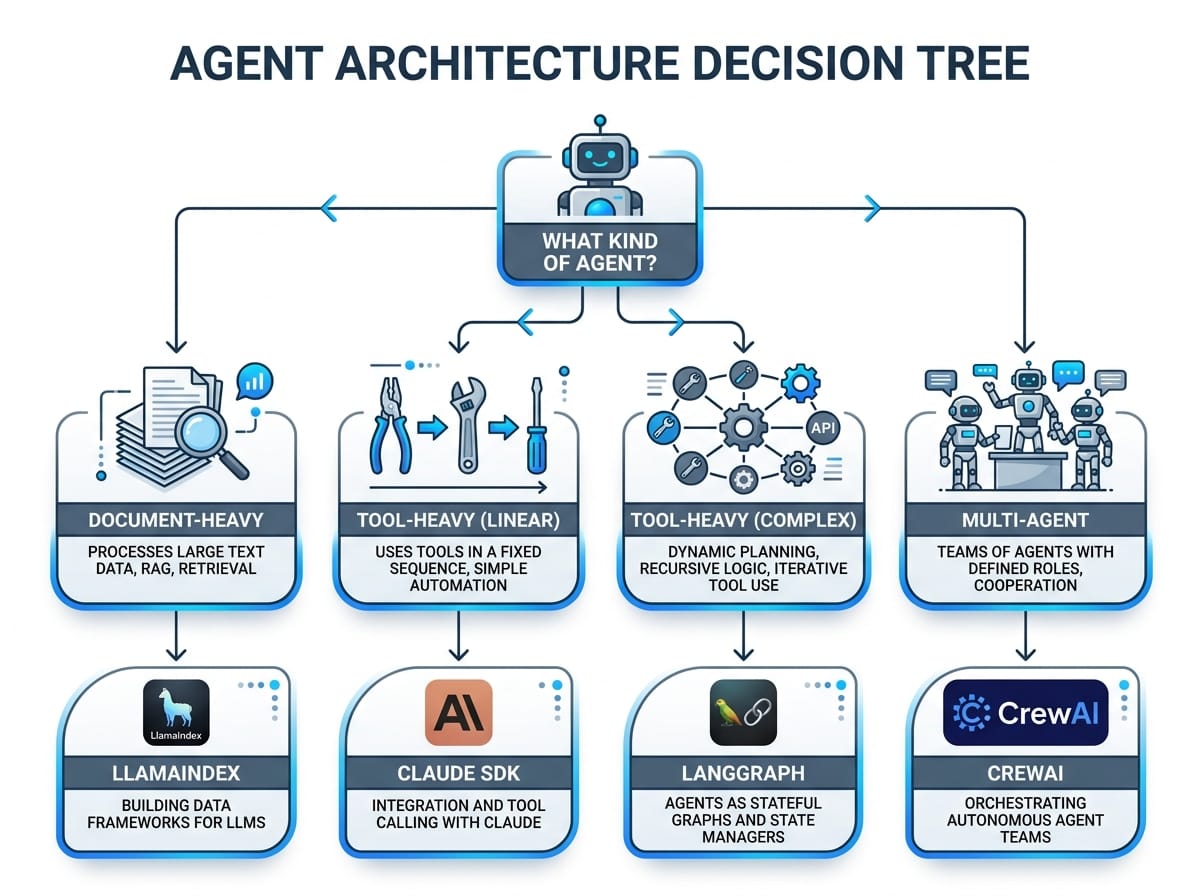
Most "framework comparison" articles produce a generic matrix. That is not useful, because the right choice depends on your specific situation. Here is the decision tree I use with clients:
Step 1: What kind of agent are you building?
- Document/knowledge-heavy: Start with LlamaIndex.
- Tool-and-action-heavy with linear flow: Provider SDK (Claude or OpenAI Agents SDK).
- Tool-and-action-heavy with complex flow: LangGraph.
- Genuine multi-agent decomposition: CrewAI (general) or AutoGen (Microsoft stack). Verify the decomposition is real before committing.
Step 2: Do you need provider portability?
If you might switch from Claude to GPT (or vice versa) without rewriting the agent: LangGraph or LlamaIndex. They abstract the LLM provider away.
If you are committed to one provider for the foreseeable future: the corresponding provider SDK gives you faster development and tighter integration. The trade is real but acceptable in single-provider deployments.
Step 3: What is the team's experience level?
For teams new to agents, provider SDKs and LlamaIndex are easier on-ramps than LangGraph. The graph model in LangGraph is powerful but takes weeks to internalize. If you have a team that needs to ship something in two weeks, do not start with LangGraph. Start with a provider SDK, learn the patterns, and migrate to LangGraph later if the orchestration complexity demands it.
Step 4: What is your tooling strategy?
If you are building tools that other agents (yours or anyone else's) will use, build them as MCP servers regardless of which framework you pick. MCP is the protocol all the major frameworks now support, and tools you build today work across the full landscape.
The second-order decisions that matter more than framework choice
Spending too much time on framework selection is a common failure mode. The decisions that actually determine whether your agent ships and works are usually elsewhere:
Task definition. The clearer the task, the better the agent. Most agent failures I see start as fuzzy problem statements that no framework can save.
Evaluation infrastructure. Build evals before you ship. Twenty real example inputs with expected outputs catches more regressions than any framework's debug tooling.
Cost management. Token usage scales fast. Use smaller models for the easy steps and reserve top-tier models for the steps that genuinely need them. Track cost-per-interaction from day one.
Observability. Log every prompt, every tool call, every response. When something goes wrong (and it will), the logs are how you debug. Pick a framework that integrates with real observability tools.
Failure modes. Decide ahead of time what happens when the LLM hallucinates a tool call, fails repeatedly, or takes too long. Building these decisions into the agent's design saves you from production fire drills.
For a deeper executive frame on AI tooling investments, the framework for responsible AI adoption covers the decisions one level above framework choice. And if you are wondering how AI agents fit into broader business operations, AI agents for business covers the strategic frame.
Getting started
If you have read this far and want to actually build something, here is the path I recommend:
- Pick a real task with a clear success definition. Something boring you do every week. Real beats clever.
- Pick the framework from the decision tree above. Default to a provider SDK or LangGraph unless your task pulls you toward LlamaIndex or multi-agent.
- Build the simplest version that works. One tool, one task, no orchestration tricks. Get it running on real data.
- Build evals before scaling. Twenty examples, expected outputs, run on every change.
- Add complexity only when the simple version fails. Multi-agent, complex routing, advanced retries are all premature until the simple version proves the task itself works.
Most agent projects that fail are not failed because the team picked the wrong framework. They failed because the team scoped the project too broadly, skipped evaluation, or burned the budget on token costs nobody planned for. The framework choice matters, but it is the third or fourth most important decision, not the first.
Frequently asked questions
What is the best AI agent framework in 2026?
There is no single best framework. LangGraph is the most flexible production option. The Claude Agent SDK and OpenAI Agents SDK are the cleanest provider-specific paths. LlamaIndex is the best for document-heavy agents. CrewAI and AutoGen are the multi-agent options. Pick based on use case, not popularity.
Should I use LangChain or LangGraph?
Use LangGraph for new projects. LangChain's core is being deprecated in favor of LangGraph for anything past linear chains. LangGraph is more verbose but more honest about the orchestration model your agent actually has.
What is MCP and why does it matter?
Model Context Protocol is the standard way LLMs discover and call tools. Originally from Anthropic, now adopted across the major LLM providers and frameworks. Building tools as MCP servers means they work everywhere instead of being locked to one framework or one LLM. For new agent projects, defaulting to MCP for tool definitions is the right call.
Are multi-agent systems better than single-agent?
Usually no. Multi-agent systems work well when the task genuinely decomposes into independent specialization, but most workflows do not. Coordination overhead and shared-context losses tend to outweigh the benefit. Default to single-agent. Graduate to multi-agent when you have evidence that decomposition helps for your specific workflow.
How much does running an agent cost?
Token usage drives cost. Simple agents on top-tier models run $0.05-$0.50 per interaction; complex multi-step agents can hit $1-$5. Smaller models (Claude Haiku, GPT-4o-mini, Gemini Flash) cost 5-20× less and are sufficient for many sub-tasks. Most teams overpay by using their best model for every step instead of tuning model size per task.
Do I need a framework at all?
For a one-off internal automation, no. Fifty lines of Python with the OpenAI or Anthropic SDK is faster than learning a framework. For anything that runs in production, scales, or needs observability, yes. The frameworks above are dramatically cheaper than rebuilding their primitives yourself.
About the author
Jess Coburn runs QIT Solutions, a managed services firm that has handled IT operations and automation for hundreds of small and mid-sized businesses since 2002. He writes about practical AI agent deployment, the trade-offs that compound at scale, and where automation actually pays off in business workflows. More posts on AI agents and automation live on the blog, and you can find him on LinkedIn.