

If you have heard people talk about "AI agents" in the last year and still cannot picture what they actually do or how to build one, you are not behind. The space moves fast, the terminology is messy, and most introductions either oversell capability or get lost in framework comparisons before explaining what an agent is in the first place.
I have spent the last two years deploying AI agents for QIT Solutions clients, ranging from MSP help-desk automation to internal-process bots that touch ten different SaaS tools. The category is finally mature enough to write about clearly. This guide is what I wish someone had handed me when I started.
What an AI agent actually is
An AI agent is a program that uses a large language model to decide what to do next. The LLM does the thinking; the agent gives the LLM the ability to act on those thoughts by calling tools, reading data, and producing output that other systems can use.
That is the entire concept. Everything else is implementation detail.
To make it concrete, here is the loop almost every agent runs:
- Receive a task or input.
- Ask the LLM what to do next, given the available tools.
- Execute whatever the LLM decided (call an API, query a database, send an email, write to disk).
- Feed the result back to the LLM.
- Repeat until the task is done or the agent gives up.
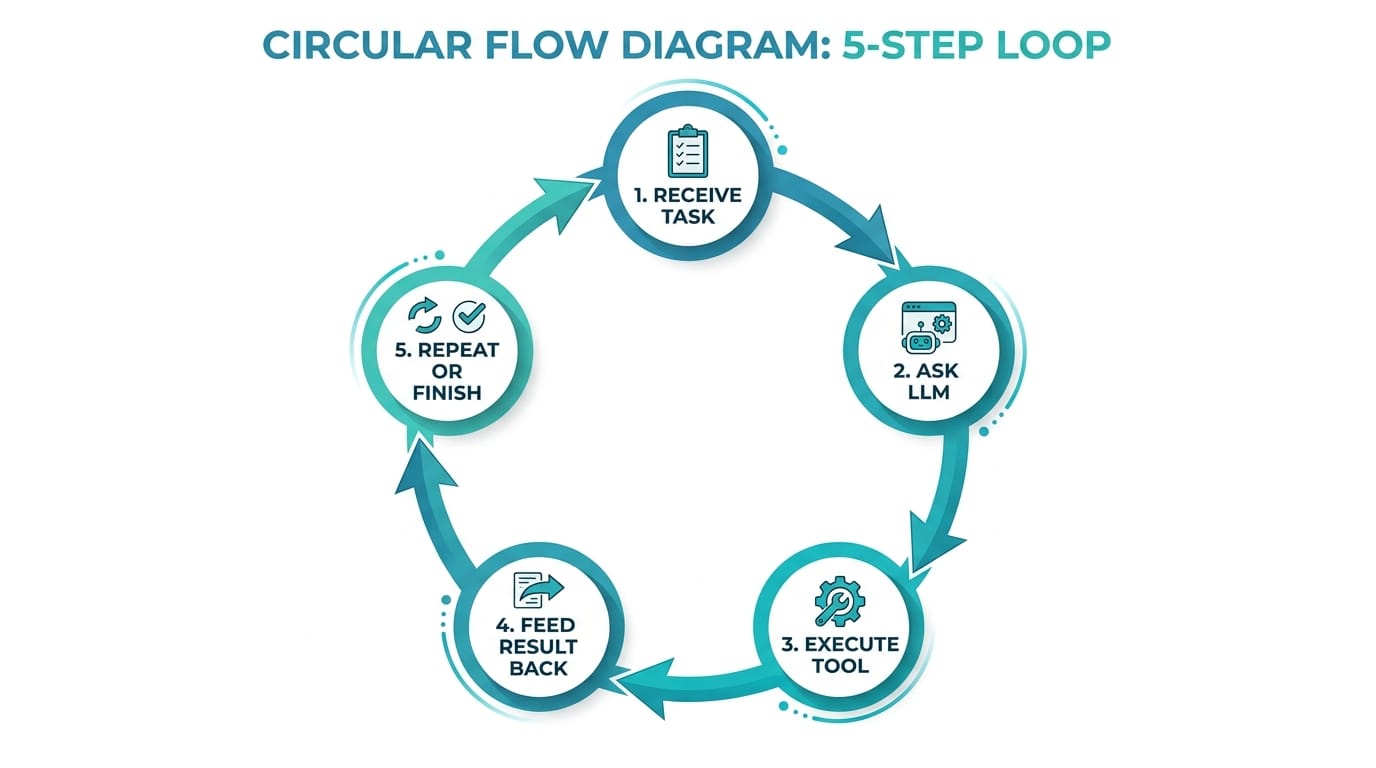
That loop is sometimes called ReAct (reason + act), sometimes called an agent loop, sometimes called something else depending on which framework's marketing you are reading. The vocabulary differs. The mechanism does not.
Why frameworks exist
You can write the loop above in 50 lines of Python with no framework at all. So why do frameworks like LangChain, LangGraph, LlamaIndex, CrewAI, and the rest exist?
Three reasons:
- Tool-use scaffolding. Wrapping every external API as a function the LLM can call, with proper schema definitions and error handling, is repetitive boilerplate. Frameworks ship this as primitives.
- Multi-step reasoning patterns. Agents that work for non-trivial tasks usually need memory, retries, branching logic, planner-executor splits, multi-agent coordination. Building each of those from scratch costs weeks. Frameworks provide them as composable abstractions.
- Observability and evaluation. Once an agent is in production, you need to know which prompts ran, which tools failed, what the LLM said before it did the wrong thing. Frameworks integrate with logging and tracing tools designed for this.
The trade-off: frameworks add a dependency you have to maintain, learn, and occasionally fight with. For a simple agent, raw Python is faster. For anything past 200 lines of agent logic, a framework usually pays for itself.
The frameworks worth knowing in 2026
The agent framework landscape changed dramatically between 2023 and 2026. Half the projects that were "must-learn" in 2024 are now deprecated or rebranded. The current landscape, as of mid-2026:
LangChain and LangGraph
LangChain is still the most widely deployed framework and the one most agent tutorials assume you know. It started as a chain-of-prompts library, expanded to cover agents, and is now reasonably stable for production use.
LangGraph is LangChain's newer cousin, focused on graph-structured agent workflows. If your agent is a single linear pipeline, LangChain is fine. If it has branching logic, multiple actor types, or human-in-the-loop steps, LangGraph is better. Most production agents I see are LangGraph these days.
Strengths: large community, deep integration with every major LLM, mature observability through LangSmith. Weaknesses: API surface is large enough that the learning curve is real, and the abstraction stack changes more often than you would like for production code.
LlamaIndex
LlamaIndex started as a retrieval-augmented generation (RAG) library and has grown into a full agent framework with strong document-and-data orientation. If your agent needs to reason over large amounts of unstructured data (your company's documents, support ticket history, codebases), LlamaIndex's data connectors are usually the easiest path.
It can do everything LangChain does, but the framing is more data-centric. For agents that are mostly RAG with a few tool calls layered on top, I prefer LlamaIndex. For agents that are mostly tool calls with a small RAG component, LangChain or LangGraph fits better.
CrewAI and AutoGen
Both are multi-agent frameworks where you define roles ("researcher," "writer," "critic") and the framework handles the coordination. The premise is that multiple specialized agents working together outperform a single generalist agent on complex tasks.
The premise is partially true. Multi-agent systems work well when the task genuinely decomposes into independent sub-tasks. They work badly when the sub-tasks share too much context or when the coordination overhead exceeds the specialization benefit. My honest take: most "multi-agent systems" I see in production would be cleaner as a single agent with better prompts. Use multi-agent when you have specifically modeled the workflow and the agents really do different things.
Claude Agent SDK and OpenAI Agents SDK
Both Anthropic and OpenAI now ship first-party agent SDKs that wrap their own APIs. These are smaller, less framework-y, and designed for the specific characteristics of their underlying models.
For an agent tightly coupled to one provider, these are usually the cleanest option. For a portable agent you want to run against multiple LLM providers, you probably want LangChain, LangGraph, or your own thin abstraction layer instead. The provider-specific SDKs are great until you decide to swap models.
Model Context Protocol (MCP)
MCP is not a framework. It is a protocol for connecting LLMs to tools and data sources, originally from Anthropic but now adopted by most major LLM providers. If you are building an agent in 2026, MCP is the standard way to expose tools so they work across LLM providers and across agent frameworks.
You can think of MCP as the USB-C of agent tooling: a standard plug that lets you swap LLMs and frameworks without rewriting tool definitions. Most of the agent frameworks above now support MCP servers as tool sources. If you are building tools you want to reuse across agents, build them as MCP servers.
How to pick a framework
Most "which framework should I use" advice gives a generic comparison matrix. That is not actually helpful, because the right framework depends on what you are building. Here is the rough decision tree I use:
Building an internal automation that calls 1-3 APIs and runs once? Skip the framework. Write 50 lines of Python that calls the LLM, parses tool calls from the response, and dispatches them. You will save more time than any framework would give you back.
Building a customer-facing agent or anything that needs to scale? Pick LangGraph or the provider-specific SDK (Claude Agent SDK or OpenAI Agents SDK) for your primary LLM. Both have production-grade observability and error handling. Avoid hand-rolling the agent loop at this scale.
Agent's main job is reasoning over your company's documents? Start with LlamaIndex. The RAG primitives are better suited than LangChain's, and you will spend less time on the data layer.
Genuine multi-actor workflow? CrewAI or AutoGen, but verify the multi-agent pattern is actually needed. Default to single-agent.
Building tools other agents will use? Build them as MCP servers. They become reusable across every framework and every LLM provider.
For a deeper look at the broader landscape, my comparison of the top AI agent frameworks covers more options. And if you want context on how to think about AI tooling investments at the executive level, the framework for responsible AI adoption has the broader strategic frame.
The mistakes I see beginners make
After helping a fair number of teams ship their first agent, the failures cluster around the same patterns. Save yourself the time:
1. Picking a framework before defining the task
"Should I use LangChain or AutoGen?" is the wrong first question. The right first question is "what does success look like for this agent?" If you cannot describe success in a sentence, no framework will save the project. Most agent failures I see start as framework debates that should have been task-definition conversations.
2. Trying to build too much in one agent
The first agent project always wants to do everything. Read emails, schedule meetings, write replies, update the CRM, generate reports. Six tools, twelve edge cases, no clear scope. These projects fail predictably.
The agents that ship successfully usually start with one tool and one task. Once that works in production for two weeks, add the second. Once that works, add the third. Iterating against real user behavior is the only way to learn what the agent actually needs.
3. Ignoring evaluation
Most teams do not build evals for their agents. They write the prompt, watch it work on three test cases, and ship. The first time the agent confidently does the wrong thing in production, they realize they have no way to detect the regression.
Build a small eval set early. Even 20 example inputs with expected outputs is enough to catch most regressions. Run the evals on every prompt change. The teams that do this ship more agents because they catch problems before users do.
4. Overlooking the cost curve
Agents call LLMs many times per task. Multi-step agents can easily spend $0.50-$5 per user interaction. At scale this is real money. The mistake is not noticing until the bill arrives.
Estimate token usage per task before you ship. Rough math: tokens-per-call × calls-per-task × tasks-per-day × LLM cost-per-token = your daily LLM bill. If the number scares you, the agent is probably not viable at the model you picked. Switch to a smaller model for the easy steps and reserve the expensive model for the steps that genuinely need it.
Getting started this week
If you want to actually build something rather than read more articles about agents, here is the path I recommend:
- Pick a real task. Something boring you do every week. Triaging an inbox, summarizing a recurring report, drafting first-pass replies to a specific kind of inquiry. Real beats clever.
- Write the agent in 50 lines, no framework. Use the OpenAI Python SDK or Anthropic Python SDK directly. Define one tool, call the LLM in a loop, parse tool calls, dispatch them. The point is to feel the loop.
- Run it on real data. Not synthetic test cases. Real inputs from your real workflow. Watch where it fails.
- Add observability. Log every prompt and every tool call. When something goes wrong, you will need this to debug.
- Once you are confident in the task, port to a framework. Now you have actual requirements. Frameworks become helpful instead of overwhelming.
That sequence will teach you more in one week than any number of framework tutorials. The frameworks are tools. The thing being built is what matters.
Frequently asked questions
What is the difference between an AI agent and a chatbot?
A chatbot responds to messages. An agent does work. The difference is tool use: agents can call APIs, query databases, write to systems, and take actions in the real world. Chatbots stay inside the conversation. Many products marketed as "AI agents" are actually chatbots wrapped in marketing copy. The diagnostic is whether the system can do something other than reply.
Do I need to know machine learning to build AI agents?
No. Building agents is software engineering, not ML. You call an LLM API the same way you call any other API. The skills you need are: comfort with APIs, basic prompt engineering, and the patience to debug LLM behavior that is statistical rather than deterministic. ML knowledge is helpful for advanced topics like fine-tuning, but most production agents never get there.
Which LLM should I use for an agent?
The strong options today are Claude (Anthropic), GPT-4 / GPT-5 family (OpenAI), and Gemini (Google). For most agent tasks, the differences between top-tier models are smaller than the differences in your prompt quality and task design. Pick one, ship something that works, and revisit the model choice once you have real production data. Switching is easy if you build behind an abstraction.
How much does it cost to run an AI agent?
Token usage drives cost. A simple agent that runs once per user interaction with a top-tier model costs roughly $0.05-$0.50 per interaction. Complex multi-step agents can hit $1-$5 per interaction. Smaller models (Haiku, GPT-4o-mini, Gemini Flash) cost 5-20× less and are sufficient for many sub-tasks. Tune the model size per step rather than using the largest model for everything.
What is MCP and do I need it?
Model Context Protocol is a standard way for LLMs to discover and call tools. You do not strictly need it for a single agent, but if you build tools as MCP servers they become reusable across LLM providers and agent frameworks. For new agent projects in 2026, defaulting to MCP for tool definitions is a reasonable architectural choice.
About the author
Jess Coburn runs QIT Solutions, a managed services firm that has handled IT operations and automation for hundreds of small and mid-sized businesses since 2002. He writes about practical AI agent deployment, the trade-offs that compound at scale, and where automation actually pays off in business workflows. More posts on AI agents and automation live on the blog, and you can find him on LinkedIn.