
The Comment Spam Challenge
Every business blog aims to foster meaningful engagement through comments. There's genuine value when readers take time to share insights or express appreciation for your content.
The frustration comes when apparent engagement turns out to be spam—automated attempts to build backlinks to questionable pharmaceutical sites or other illegitimate businesses. This wasn't just an annoyance; it was actively damaging the professional reputation of business websites.
Traditional anti-spam plugins and services provided limited protection. The fundamental problem was reactive defense—a constant cat-and-mouse game where spammers would quickly adapt to bypass new blocking mechanisms.
A Cloud-First Security Approach
In 2011, I encountered CloudFlare's innovative solution that addressed spam protection through a fundamentally different approach: moving security to the network edge through a content delivery network (CDN) combined with web application firewall capabilities.
CloudFlare's three-pronged value proposition was compelling for business websites:
Performance Optimization
- Caching, compression, and optimization of static content
- Global CDN distribution for faster load times
- Reduced server load through edge delivery
Security Protection
- Real-time blocking of known spammers and malicious bots
- Protection against cross-site scripting (XSS) attacks
- Comprehensive threat intelligence integration
Operational Efficiency
- Prevents bots from consuming server resources
- Improves overall website performance
- Reduces infrastructure costs
Implementation Insights
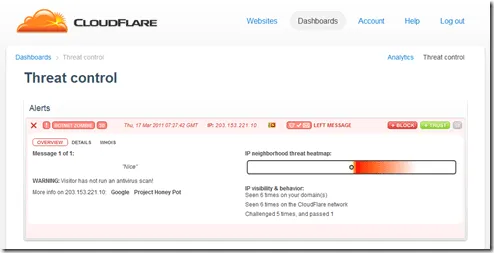
The CloudFlare dashboard provided comprehensive visibility into threat patterns and security events. The platform's threat control panel revealed the scope of automated attacks that most website owners never realize they're experiencing.
Geographic blocking capabilities proved particularly valuable, allowing granular control over traffic sources while maintaining legitimate business access. The ability to implement these controls at the network edge, rather than consuming web server resources, represented a significant operational improvement.


Strategic Implications
CloudFlare's approach in 2011 anticipated what would become standard practice: cloud-based security services that combine performance optimization with threat protection. This early implementation of "security as a service" demonstrated the viability of moving critical security functions away from individual servers to specialized cloud platforms.
For business leaders, this represented a shift from reactive security management to proactive, intelligence-driven protection. The economic model was particularly attractive—comprehensive security and performance improvements with minimal upfront investment.
Looking Back: Early Cloud Security Adoption
While CloudFlare experienced some growing pains as a young platform in 2011, their fundamental approach proved prescient. The integration of CDN services with web application firewall capabilities became an industry standard, validating the strategic value of cloud-first security architectures.
This experience reinforced a key principle: effective cybersecurity often requires moving beyond traditional perimeter-based defenses to embrace cloud-native solutions that can scale with threat volumes and adapt to evolving attack patterns.