

Why replacing employees with AI keeps backfiring
Every time I sit down with a business owner to talk about AI, the conversation starts the same way. "How many people can I cut?" Or some polite variation. "Which roles can AI take over?" "Can I replace my service coordinator with a chatbot?"
I get it. Payroll is probably your biggest expense. If technology can shrink it, that drops straight to the bottom line.
Except it doesn't work that way. And we have receipts.
Klarna, the Swedish fintech company, cut 700 customer service workers in 2023 and handed everything to AI chatbots. Their CEO told the press that AI could do every job a human could do. They saved $10 million. Then customers started leaving. Complex issues piled up unresolved. Satisfaction cratered. By 2025, Klarna was quietly rehiring human agents and their CEO was publicly admitting they'd chased efficiency at the expense of quality.
They're not alone. McDonald's pulled its AI drive-through system after it kept adding hundreds of chicken nuggets to orders. Air Canada's chatbot fabricated a bereavement fare policy that didn't exist, and when a customer relied on it, the company tried to argue the chatbot was "a separate legal entity." I wish I was making that up.
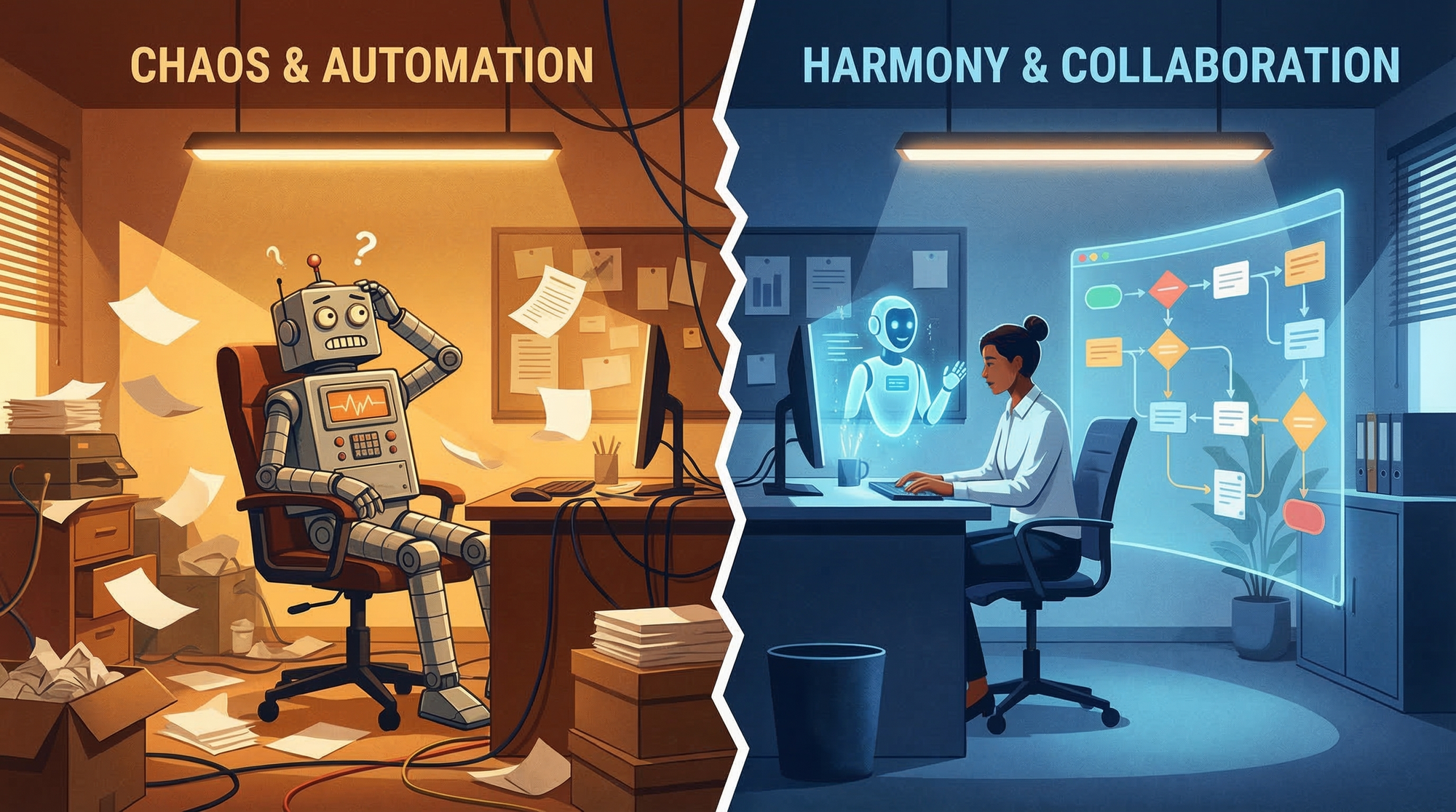
Every one of these companies made the same mistake. They used AI to replace people instead of fixing the broken processes underneath. If you're thinking about adopting AI responsibly, that distinction is where it all starts.
How AI agents actually work inside an SMB (our results)
I run an MSP. We've been using AI agents inside our own operation for a while now, and honestly, the results looked nothing like the headlines.
We didn't cut anyone.
What happened was the opposite. We started using AI to handle the research, information gathering, and discovery work that used to eat hours out of every day. Pulling data from multiple systems. Compiling reports. Digging through documentation before a client meeting. The stuff that's necessary but tedious, and that nobody went into IT to do.
This hasn't translated into less employees but rather more efficient and productive employees. Our team does better work because they're not spending half their day on tasks a machine can handle faster. They focus on the problems that actually need a human brain.
We're not an outlier here. A PwC study covering a billion job ads found that industries most exposed to AI saw nearly four times the productivity growth of less-exposed industries. And job availability still grew 38% in the most AI-exposed roles. A large-scale study of over 12,000 European firms found AI adoption raised labor productivity by 4% on average, with no evidence of reduced employment in the short run. Even a Fortune 500 customer support study showed AI boosted productivity 15% across the board, with the least experienced workers gaining the most (36%).
What the research actually shows
4x
productivity growth in AI-exposed industries vs. others
PwC 2025 Jobs Barometer
38%
job growth in the most AI-exposed roles
PwC 2025 Jobs Barometer
2.8x
more likely to see EBIT impact when workflows are redesigned first
McKinsey State of AI 2025
21%
of organizations have done any meaningful workflow redesign
McKinsey State of AI 2025
People aren't getting fired. They're getting better at their jobs. That's a fundamentally different story than what most of the press is telling you. And it's the same pattern playing out across the workforce more broadly.
Why AI agents need human oversight (they're interns, not executives)
Here's where I lose a lot of business owners. Today most businesses hear AI and think magic. They think they're buying a senior employee who works 24/7, never complains, and costs a fraction of a salary.
That's not what they're getting.

AI agents are similar to inexperienced first year interns. They understand some of the principles and concepts but they don't have the experience or judgement that comes with experience. They need a lot of instructions and oversight initially, and as they get better they need a little less. But they never become fully autonomous. Not yet. Probably not for a while.
I didn't pull that comparison out of thin air. Citi Ventures said almost the same thing in MIT Sloan Management Review: AI agents should be treated like coworkers who need to be trained, coached, and supervised. IBM's agentic AI security guide uses the same framing, comparing it to handing an intern the authority to make thousands of decisions without anyone watching.
And the numbers bear it out. The AI Now Institute found that AI systems with limited human oversight showed 2.4 times more bias than supervised ones. Algorithmic failures occurred 3.7 times more frequently without human supervision.
You wouldn't hand your most critical client relationship to a first-year intern and walk away. So why would you hand it to an AI agent?
The AI process automation checklist: 8 questions before you deploy
When someone tells me they want to deploy AI agents, I walk them through a series of questions before we touch any technology. If a process doesn't pass this filter, it's not ready. Full stop.

Is the process documented? If it only lives in someone's head, stop here. You can't automate what you can't describe.
Can you map the inputs and the outputs? What goes in, what comes out, and what happens in between? If you can't draw it on a whiteboard, an AI agent can't execute it.
Are errors recoverable? If a mistake means someone gets hurt or the business faces a lawsuit, this isn't an AI candidate right now.
Is this repeated by the same person, taking 30 minutes or more each time? If it's a one-off task or takes two minutes, the overhead of setting up an AI agent isn't worth it.
Does it need real-time physical judgment? If someone needs to be on-site reading the room, AI can't help you.
Do the outcomes carry serious legal or safety stakes? Compliance filings, medical decisions, financial advice with fiduciary obligations. Leave those to humans for now.
Are the systems actually connected? AI agents are only as useful as the data they can reach. If your platforms don't talk to each other, fix that first. This is the same kind of infrastructure decision that compounds over time if you get it wrong early.
Is this something a spreadsheet, a Google search, or a phone call can solve? If the answer is yes, you don't need an AI agent. You need a simpler tool or a human relationship.
If a process clears all of those? Now we're talking.
Why workflow redesign is the biggest predictor of AI ROI
I put documentation first in that checklist on purpose. It's the step almost everyone skips, and it's the one that determines whether everything else works or doesn't.
McKinsey's 2025 State of AI survey tested 25 different organizational attributes to find which ones had the most impact on bottom-line results from AI. Workflow redesign came out on top. Not the model. Not the budget. Not the vendor. How companies structured their processes before deploying AI was the single biggest driver of EBIT impact.
High-performing AI organizations were 2.8 times more likely to have fundamentally redesigned their workflows (55% versus 20% of everyone else). But only 21% of organizations had done any meaningful redesign at all. That gap is the whole story of why most AI projects disappoint.
If you automate a bad process, you get a faster bad process. AI amplifies whatever you point it at. Point it at chaos and you get faster chaos.
McKinsey's more recent work on agentic AI reinforces this. They draw a line between processes that just need simple task automation (payroll, password resets, expense approvals) and ones that warrant full redesign. The indicators for redesign include high coordination overhead, rigid sequences that slow responsiveness, and frequent human intervention for decisions that could be data-driven. If that sounds like what your team complains about every week, it probably is.
How to start automating business processes this week
Here's what I want you to walk away with. Stop thinking about AI as a headcount tool. Start thinking about it as a process tool.

This week, ask your team one question: "What do you repeat every week that you wish someone or something else would handle?" Collect the answers. Look for overlap. If three people mention the same pain point, that's your starting line.
Pick one process. Just one. Document it. Map the inputs and outputs. Run it through the checklist above. If it passes, find the right tool for that specific workflow and test it for 30 days. Measure completion rate, error rate, time saved, and what your team thinks of the change.
Then decide whether to expand based on evidence, not excitement.
The companies getting real results from AI right now aren't making headlines about replacing their workforce. They're the ones quietly fixing broken processes, one workflow at a time. That's not as sexy as "AI replaces 700 employees." But it's the version that actually works.
Jess Coburn started building internet infrastructure in the late '90s, spent two decades scaling managed IT and cloud services, wrote the #1 Amazon bestseller on cybersecurity for small businesses, and now helps businesses define their own AI strategy. He's watched every major technology hype cycle up close and writes about which ones actually matter. Subscribe here.