
The Platform Wars of 2007
In February 2007, a significant shift occurred in enterprise web development. Mike Volodarsky, a product manager with Microsoft's IIS team, released a comprehensive tutorial enabling Ruby on Rails to run natively on Windows with IIS FastCGI. This represented a pivotal moment for Windows-based development shops.
The web development community had been divided along platform lines. Linux advocates championed Ruby on Rails as proof of their platform's superiority, while Windows developers defended their ecosystem with ASP.NET, C#, and AJAX capabilities. However, the absence of stable Ruby on Rails implementation on Windows created a genuine competitive disadvantage.
Bridging the Technology Gap
Prior to this breakthrough, Windows developers relied on alternative frameworks like Monorail and SubSonic to approximate Rails functionality. While these solutions provided some capabilities, they weren't true Ruby on Rails implementations.
The introduction of FastCGI TP2 for IIS changed this dynamic entirely. Suddenly, Windows servers could support the complete spectrum of web technologies:
- ASP and ASP.NET (.aspx)
- PHP (.php)
- Python (.py)
- ColdFusion (.cfm)
- JSP (.jsp)
- Ruby on Rails (.rb)
Implementation and Deployment Challenges
Despite this technological advancement, practical deployment faced several constraints. Most shared hosting providers weren't prepared to offer Ruby on Rails in their environments. The tutorial required wildcard mapping functionality unavailable in Windows XP, limiting development environment options.
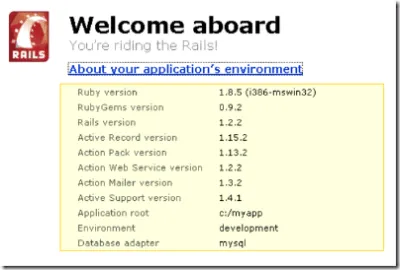
However, virtual private server (VPS) technology provided a viable path forward. I successfully tested the implementation on our Windows VPS infrastructure running Virtuozzo, achieving full functionality by following Volodarsky's tutorial with only minor path corrections needed.

The VPS Advantage
The timing aligned perfectly with advancements in virtualization technology. Virtuozzo for Windows had matured significantly since its 2004 beta releases, addressing earlier performance and stability concerns. This created an opportunity for scalable Ruby on Rails deployment on Windows infrastructure.
VPS technology offered unprecedented flexibility: dynamic resource allocation, seamless migration between hardware nodes, and upgrade paths from development servers to dedicated infrastructure without service interruption or data migration.
Strategic Impact and Legacy
This development represented more than technical compatibility—it eliminated a significant barrier for enterprises standardized on Windows infrastructure. Organizations could now evaluate Ruby on Rails based on technical merit rather than platform constraints.
The breakthrough demonstrated how strategic technology partnerships and cross-platform compatibility could reshape competitive dynamics in enterprise software markets.
Validation and Testing
To verify full functionality, I implemented a complete "Hello World" Rails application, confirming that the integration extended beyond basic installation to actual application development and deployment capabilities.

Why This Still Matters
While Ruby on Rails has evolved significantly since 2007, this milestone illustrates a crucial principle: platform exclusivity often represents artificial constraints rather than technical necessities. Today's cloud-native and containerized environments echo the flexibility that VPS technology began enabling in 2007—technology choices should be driven by business requirements, not infrastructure limitations.